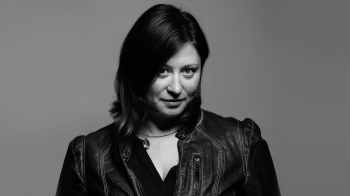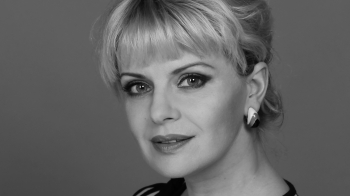
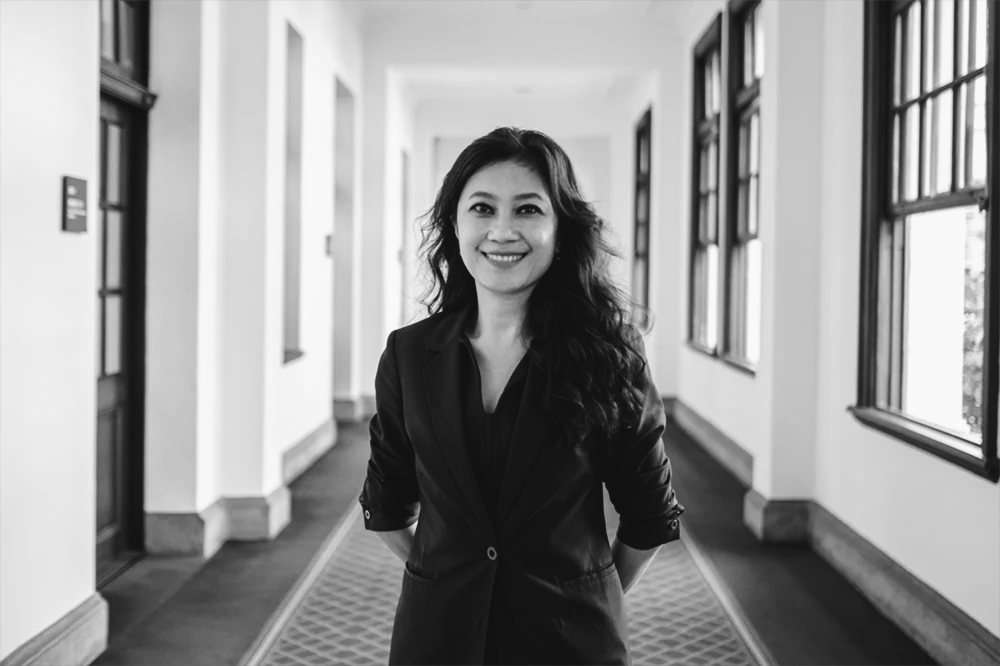
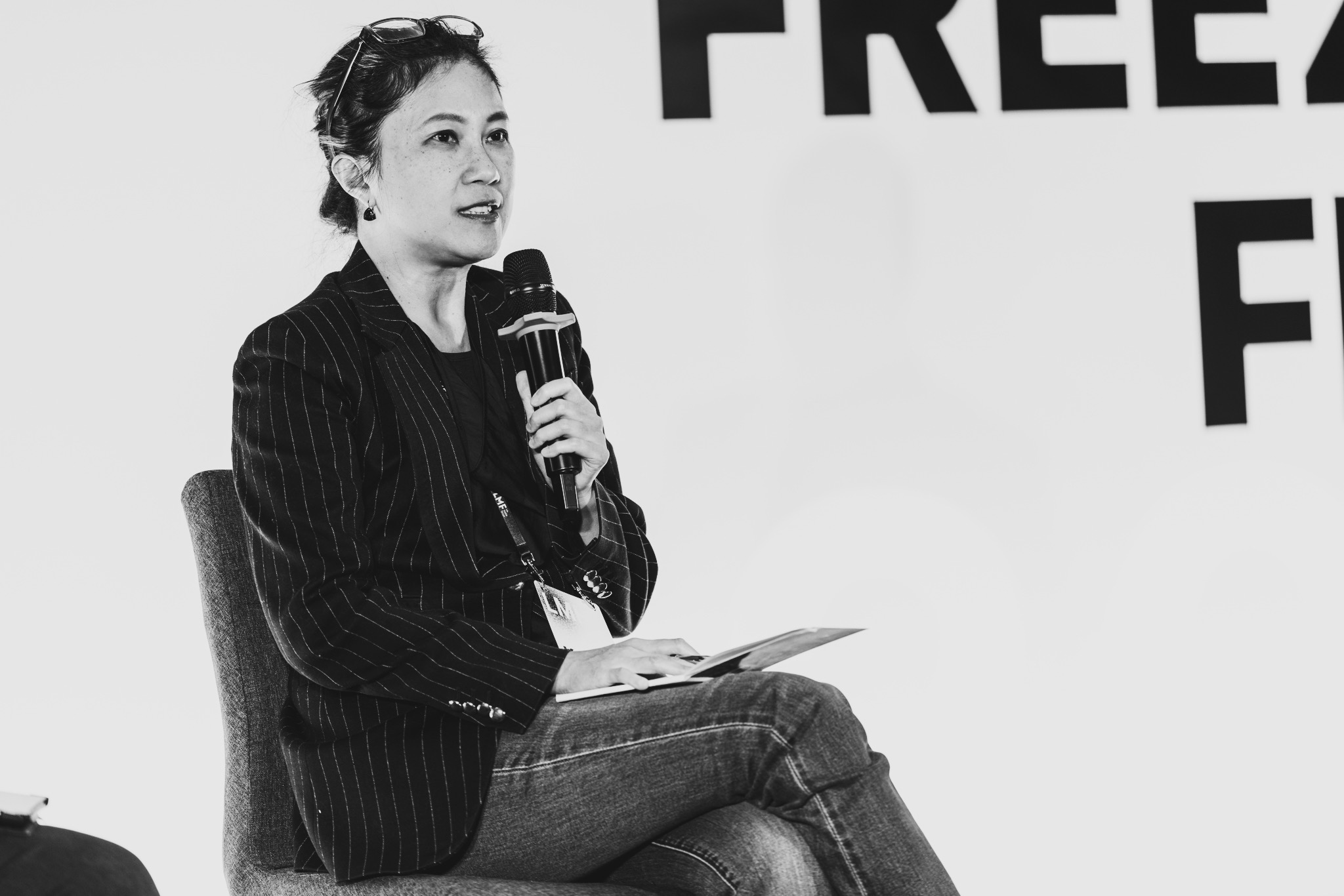
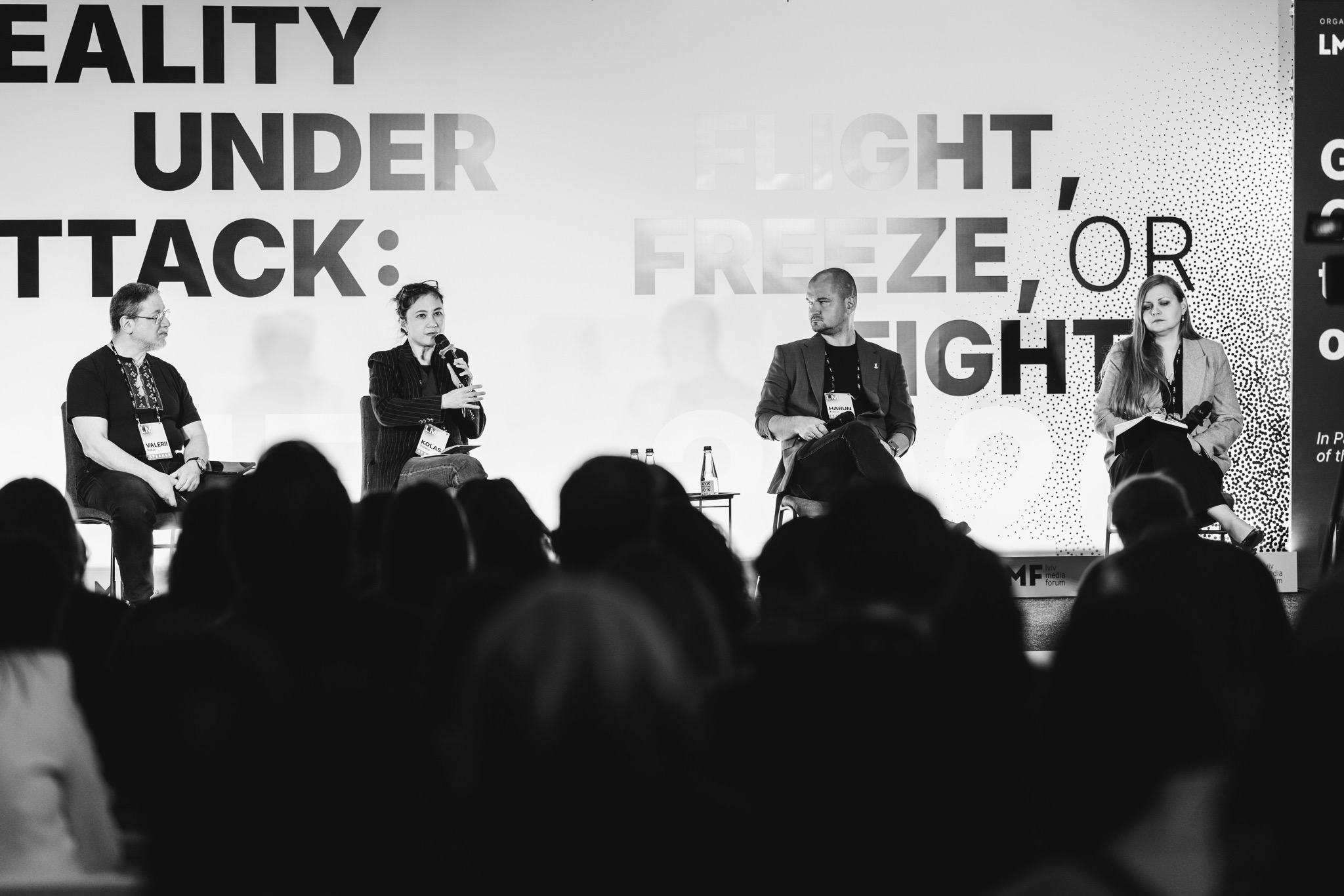
Kolas Yotaka is a Taiwanese author and researcher focused on democracy, security and disinformation. A member of the Pangcah indigenous people, she served as Presidential Office Spokesperson under President Tsai Ing-wen. She was the first indigenous Taiwanese to hold that position and the first person in the country’s history to hold public office under an indigenous name. Trained as a sociologist, she spent fifteen years as a television and print journalist before entering politics. She served as a legislator during the first DPP majority in Taiwan’s history, then as Cabinet Spokesperson and Presidential Office Spokesperson. She now researches, writes, and speaks on information warfare and democratic resilience.
Taiwan was always a reference point for Ukrainians: a small democracy under existential threat from a large neighbor, technologically advanced, socially united, backed by the US. But I realize we actually know very little about you. So let me start from the beginning: what does Taiwan actually look like from the inside right now?
It’s very diverse. Taiwan has many different languages. Mandarin Chinese is the most widely used, but there is another very strong language – Taiwanese, spoken by about 80% of the population. Mandarin became the “national language” only in the 1950s when the Chinese Nationalist Party made it mandatory, before that it wasn’t even spoken in Taiwan. And I myself am not Chinese – I’m indigenous. Totally different people. We are considered Polynesian, closer to Native Hawaiians or the Māori from New Zealand than to Han Chinese. Taiwan was never a unified part of China. That’s the core argument of my book. Four hundred years ago, we were colonized by Spain, then the Dutch, then the Qing Dynasty, then Japan for half a century. My grandfather was Japanese. So when people ask whether Taiwan is part of China, I say: no, that is simply fake news. China is a large country and has been pressuring other nations to accept its narrative that Taiwan is part of China, that everyone is Chinese. But it’s not true.
Russia is doing the same thing. And I think my book might resonate strongly with Ukrainians for precisely that reason.
You wrote in your book The Gift about Taiwanese identity. Tell me about the title. What is the gift, exactly?
It has a double meaning. In Chinese, the same as in English, the word means a ‘present’, something given to you. But it also carries the sense of being gifted, of a quality or capability you were born with. So identity itself is the gift. The fact of who you are – your origins, your languages, your history – that is something you were born into, and you have to be brave enough to embrace it. Like a child receiving a present: you have to open it, look into it, not let someone else tell you what’s inside or take it away from you. Don’t be brainwashed by Chinese propaganda into calling yourself Chinese. You can acknowledge Chinese ancestry and still be proudly, fully Taiwanese.
And after China officially condemned you at a press conference, does that change what the gift feels like to hold?
I take that as a badge of honor. A trophy, really. I don’t think there is any other author whose book was condemned by the Chinese government personally, officially, at a press conference. So it clearly worked.
The book combines my personal experience with my political career and brings together domestic and international affairs to show the true face of Taiwan in the 21st century. I have two audiences – Taiwanese readers and international readers. For Taiwanese, I am challenging them: who are you? Who are we? We can have Chinese descendants, indigenous descendants, Vietnamese, Indonesian, Japanese descendants – all kinds of people in Taiwan – and still be proudly Taiwanese. For international readers, I want to show that Taiwan is not simply a democratic version of China. It is a sovereign, distinct country.
We have a big decolonization movement in Ukraine right now: not only about how others see us, but about how we see ourselves, clearing away internalized misconceptions. Are there similar processes happening in Taiwan, especially among young people?
Definitely, especially in the younger generation – you can feel the energy.
But we are very influenced by Japan and Korea in terms of popular culture. Young people today, you can tell by the way they dress, the music they listen to, and even the languages they study. My generation was more pro-Europe, pro-America. But the younger generation is very oriented toward Japan and Korea.
Everyone everywhere is influenced by Korea right now. K-pop, Korean films, Korean books. In Ukraine as well.
Even books, yes. It’s remarkable. Though I think the generational shift goes deeper than just cultural taste. We’ve had direct presidential elections since 1996. Whoever was born after 1996 was born into democracy and knows nothing else. I was born under martial law, under a dictator. People like me experienced that period directly.
The same with the Ukrainians born after independence in 1991. They never knew the Soviet Union. Though it's not always that clean, some absorbed a Soviet mindset from their parents without realizing it. The transmission isn't only through direct experience.
Exactly. You see very different personalities across generations. The younger ones are more carefree, maybe a little spoiled. Which is natural. But they are also the generation that will decide Taiwan’s elections and its future.
So what conversations about the future are actually happening in Taiwan right now? And how does living for so long next to a clear existential threat shape the way people think about that future?
It splits along generational lines. People under 40 care primarily about the economy: work, income, salary, housing, AI, parenting. They don’t engage much with inter-party political debates. People who are a little older, who still watch television, who read current affairs magazines, think about geopolitics seriously. They ask: Will China attack us? Will we be the next Ukraine? The younger generation has something like an illusion of safety. They don’t feel the threat viscerally.
That reminds me of what happened in Ukraine. Even after 2014, knowing what Russia was, it was hard for most people to imagine the worst-case scenario. The cultural entanglement made everything harder. Young people who considered themselves completely Ukrainian, no question, but whose favorite singer, favorite writer was Russian. Grandmother from Russia. So Russia didn't feel like the enemy. That was maybe a bigger problem than any economic or geographic connection. Do you have the same kind of cultural entanglement with China?
Of course. Around 80% of Taiwanese have ancestors who came from China, some 400 years ago, which is longer ago than the founding of the United States. We eat with chopsticks; we share food culture. People feel related. But there is a political party exploiting that ancestral connection to push Taiwan closer to China. And right now, that party holds the parliamentary majority. They have been blocking our defense budget and spreading Chinese propaganda. They are clearly acting as agents of Chinese influence.
Did the war in Ukraine change anything concretely for Taiwan in terms of policy, defense posture, or what people expect from the future?
Taiwanese people really support Ukraine. You cannot imagine how much. We feel the projection deeply: Ukraine is fighting our fight. But beyond solidarity, yes, it changed things concretely. Taiwan was essentially a baby in terms of the drone industry. We had nothing. Since 2023, the Ministry of Defense has started investing seriously, and the president has been traveling to find partners to establish a drone industrial park. That shift came directly from watching what you were experiencing. And social media made it immediate – when footage of what war actually looks like started circulating, it changed something in people’s minds. Before the invasion, China had been making threats for 70 or 80 years and people had mostly stopped believing they would actually act.
What's more present for Taiwanese people – exhaustion from constant anticipation, or something closer to forgetting?
It’s become very ugly, because it has turned into a domestic political weapon. The pro-China parliamentary majority has been using Ukraine as an example, arguing that if you raise the defense budget, you are rejecting the peace plan, you are preparing for war, and therefore inviting attack.
Their so-called peace plan means Taiwan has to admit it is part of China, and then they promise no war. It doesn’t work like that. So this is a real political war inside Taiwan, and it maps closely onto what happened in Ukraine: red lines that keep shifting, politicians acting as proxies, using every dispute to blockade defense spending.
You write that democratic dysfunction itself can become a national security vulnerability – that the parliamentary bloc blocking defense spending is not just a political problem but an existential one. What does democratic resilience actually look like to you in that context? How do you defend democracy from within when democracy itself is being used as the weapon against you?
Resilience comes from the people. The power of the people is what matters. The foundation of democracy is accurate, transparent information. When people have access to enough of it, they can make the right decisions for themselves. So the right sources of information – disciplined, healthy journalism and media – are the key to resisting populism and preventing the polarization of public opinion.
You write in English for international audiences and in Chinese for Taiwanese. Does your emotional register shift between languages? Are there things you can say in one that you genuinely cannot say in another?
I think I'm comparatively unusual because I have so many languages: Mandarin, Taiwanese, Hakka, some Japanese from my family, and now English for work. Among Mandarin, Taiwanese, and Hakka, switching is effortless; they are close enough. But English is genuinely different. I have to think before I start. It's a different mode entirely. Internally, I feel like the same person, but the audience shapes everything.
You are a Pangcah Indigenous woman who has served as a legislator, presidential spokesperson, entrepreneur, and now writer. Which of those roles feels most like your natural voice – and does language play into that? Is there a version of you that exists most fully in Amis, or in the political register, or on the page?
I try to hold onto myself in every role, but I also lose a little of myself in each one. As a descendant of indigenous people, we have had to compromise with outside colonizers – to enter modern political institutions, to communicate in languages they understand, to pursue our ideals step by step. If there is any moment when I can be completely myself, it is during our annual ceremonies. When I put on my traditional clothes and sing with my people, I have no identity at all – I am the same as everyone else: a descendant who must follow the teachings of the ancestors, holding hands in a circle, moving together, round and round. That is when I am whole.
What should small democracies do when they can no longer rely on large partners to protect them? Ukraine is learning this in real time. How do you think about it for Taiwan?
No matter who tells you they will defend you, stand next to you, be with you – at the end of the day, it comes down to you. Even coming here to support Ukraine – after I go back to Taiwan, it’s still only you. You have to fight your own fight. No matter what the US does or doesn’t do, what Japan does or doesn’t do – only you can actually move. You have no option to step back. So you try whatever you can and keep going. That’s why memory matters so much. You can’t forget how painful the first attack was and just move on as if it didn’t happen. You carry the wound with you – not to be paralyzed by it, but to remember what you are protecting. For a person it’s like that. For a country it’s like that.
You write very realistically about US national interests – without romanticizing the alliance. Do you think smaller democracies need to emotionally detach from the idea of guaranteed protection? And if so, what does that detachment look like in practice — is it psychological, strategic, or both?
Both. We have to understand that different countries have different national interests. Taiwan’s interests are not the same as America’s, not the same as Japan’s. We may happen to share an interest in defending the same sea or the same land – but any protection on offer is temporary. In the end, you walk through that war alone.
You've written about information warfare succeeding not by convincing people of lies, but by exhausting them psychologically until they stop caring what's true. What narratives about Taiwan worry you most right now — the ones that are doing that kind of damage from the inside?
Taiwan is flooded with disinformation, and social media amplifies exaggerated, sensationalized content. People scroll through so much information that they end up chasing the stimulation – the political shouting matches, the politicians who’ve learned to mock their opponents with stand-up comedian punchlines, the crude attacks and cheap jokes. It distracts people into thinking the joke itself is the point, leaving them too overwhelmed to check what’s actually true. The most insidious narrative right now is the one being spread by various political factions: that if Taiwan simply accepts the CCP’s legitimacy, China won’t attack by force.
What is the state of cultural life in Taiwan right now? In Ukraine, we have a boom in theater – a direct creative response to the war. And we have institutions supporting it: a Book Institute, a Ukrainian Institute, the Ministry of Culture, many private initiatives. What does that infrastructure look like in Taiwan?
Actually, Taiwan's strongest form of soft diplomacy has not been cultural; it's been medical. Taiwan has a strong medical system, and for decades, the government has been sending doctors and nurses to countries that need them, including Ukraine. Even countries that don't officially recognize Taiwan as a state will accept Taiwanese doctors. It's people-to-people diplomacy, completely removed from politics. And now drone diplomacy may become even more significant.
As for literature and culture – honestly, I don't see a mainstream cultural boom the way you describe in Ukraine. China has had an enormous influence on Taiwanese drama and film. There are people still making movies, writing books, producing documentaries — but they are not mainstream. The mainstream mood is more practical, more economic. People work long hours all week and on weekends they want to escape — travel domestically, take the kids out. There's always terrible traffic out of Taipei on Fridays because everyone is trying to get away. People are using travel as an escape from the pressure they don't want to face directly.
You warn against Taiwan simply adopting either American or Chinese narratives wholesale about itself. What would an independent Taiwanese cultural and strategic vision actually look like — and is literature part of how you build it?
Taiwan is enormously diverse and should not be defined by any other country. Taiwan is not “part of China” as Beijing claims, nor is it “a more democratic version of China” as some Americans imagine. Taiwan is an independent country, not a dependency of anyone. We have different peoples, languages, cultures, beliefs, food, and political systems. I believe Taiwan needs to build its own historical perspective – the capacity to construct its own national narrative and to refuse to be constrained by China’s version of history. So yes, literature and history will be central to building a sovereign national identity.
Last question. What are you taking back with you from Kyiv?
This is my first time in Ukraine. After the full-scale invasion, all the images I had seen were bombing, people dying, President Zelenskyy speaking in front of cameras in the dark. People in Taiwan assumed every corner of Ukraine looked like that. It actually doesn’t. I heard sirens a couple of times, but the cities are functioning; they are beautiful, and the people are out. What I feel most strongly is that you are strong. The courage here, the resilience — I’m honestly not sure if Taiwan could do the same if China really bombed our capital. Resilience and courage are the two things I want to bring home.
Kolas Yotaka is a Taiwanese author and researcher focused on democracy, security and disinformation. A member of the Pangcah indigenous people, she served as Presidential Office Spokesperson under President Tsai Ing-wen. She was the first indigenous Taiwanese to hold that position and the first person in the country’s history to hold public office under an indigenous name. Trained as a sociologist, she spent fifteen years as a television and print journalist before entering politics. She served as a legislator during the first DPP majority in Taiwan’s history, then as Cabinet Spokesperson and Presidential Office Spokesperson. She now researches, writes, and speaks on information warfare and democratic resilience.