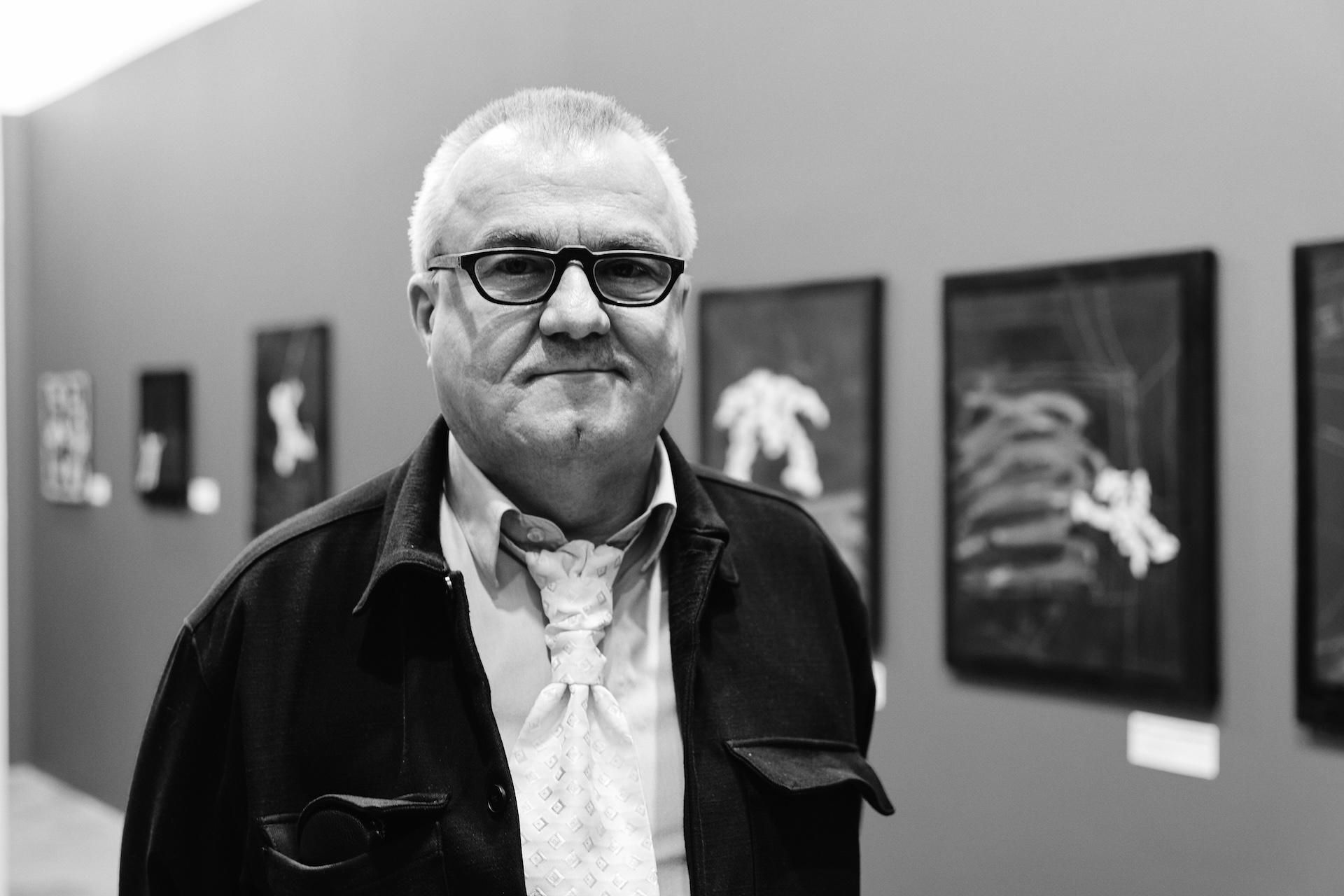
dr.Máriás is a Hungarian visual artist and musician born in Novi Sad, Yugoslavia. Working across painting and performance, he is known for his provocative, darkly comic canvases that place historical monsters and political figures in absurd, often surreal juxtapositions — Stalin as Manager of the Year, a feminist Mussolini, vampire George Soros. His work draws on decades of living inside and against authoritarian systems, from Tito's Yugoslavia to Orbán's Hungary, where he was effectively blacklisted from state institutions for over a decade. His 2026 exhibition Long Live Dictatorship opened alongside the publication of his memoir, marking both a personal retrospective and a reckoning with Hungary's political transformation.
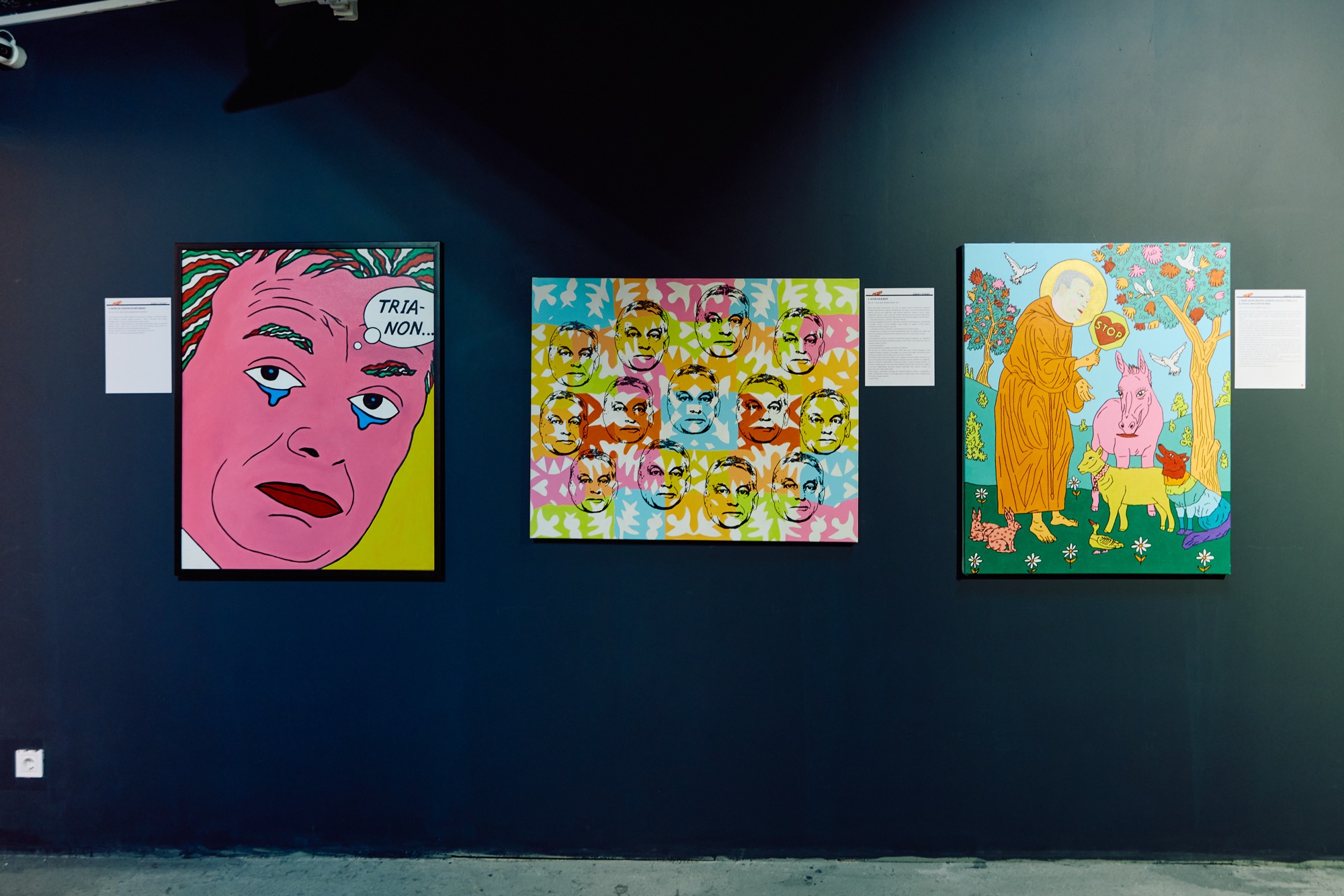
In your 2025 book, you frame Péter Magyar’s rise as a kind of unexpected royal succession: Viktor Orbán begins as the “good king,” becomes the “bad king,” and is eventually challenged by one of his own pupils — Prince Péter. You write that if the king is pulled from the throne, “everything can finally begin all over again from the beginning.”
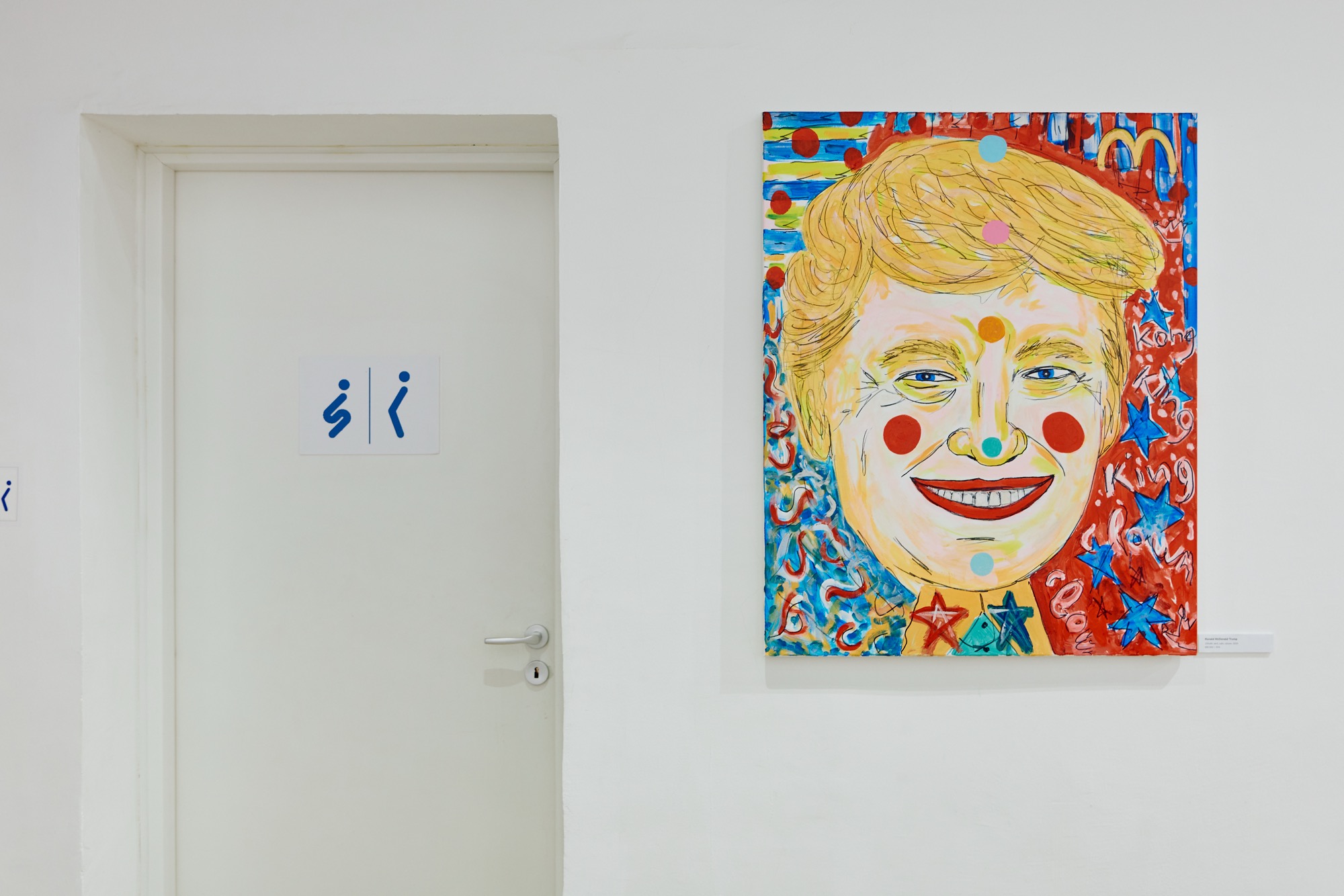
Your 2024 painting of Magyar was made just as he and the Tisza party emerged from inside Orbán’s own system and began its challenge of Orbán and Fidesz. Nearly two years later, Prince Péter defeated King Orbán.
How did you experience this “change of king”? Do you see it as a real change of system, or simply another cycle beginning again? How does this question connect to your “Long live the dictatorship!” exhibition?
%20(1).png)
Well, this is the eternal polemic: have we now been liberated for the first time, or for the hundredth time, or yet again? Or does it only seem, for a brief transitional period, that we have been liberated — only to then realize that we haven’t been liberated?
Obviously, in the world we live in, this uncertainty, this melancholy mixed with optimism, this anger or hope is mixed with pessimism. These things somehow always go hand in hand. And it’s not uncommon for us in this region: we have a great deal of bad historical experiences with such things.
We are in what might be called a blessed moment. Hungarian politics appears to be reorganizing itself completely from zero. Everyone has great expectations and hopes. If the hopes are too high, that’s not good. But we were in a situation where many people now think that whatever comes next can only be better.
I trust that as a result of what one might simplify as a generational shift, there will be a rejuvenation and renewal of Hungarian society – and hopefully at every level of it, including culture and art – which will once again approach the values and unresolved problems we live among with momentum, interest, and conscience.
This eternal mixture of pessimism and optimism gave my exhibition its title: Long Live Dictatorship. The title is obviously very strongly worded, and it is no coincidence that, alongside the publishing of my book and the opening of this exhibition, I was living through what we did not yet know at the time were the final months of a rather dictatorial system.
I consider the greatest danger to be the way a dictatorial system lives with us, so to speak, and becomes part of our conformism. In post-socialist countries, it is very difficult to distance oneself from old patterns, and very difficult to introduce and have accepted new patterns that break with them — especially when they are sensitive or less pleasant, and when renewal is attempted through different mental or civilizational attitudes.
I was born in Yugoslavia, in Tito’s dictatorship. It may have seemed comparatively milder than the Hungarian one, but beneath the surface was just as harsh as the other Eastern European dictatorships. I then lived through Milošević’s wartime regime, spending my university years in it, and then had to flee to Hungary, where I experienced the democratic attempts of regime change. Then, of course, came all kinds of restoration of the old mindsight, the increasing strengthening of a somewhat retrograde mentality, and later its ever more vulgar unfolding and reembedding in society.
I will turn 60 years old this year. And I have spent the past four decades as an artist. The title of this exhibition probably isn’t the most cheerful. But with its very strong directness, it certainly provokes reactions in people. And that’s what I hope to accomplish with my paintings as well.
In a certain sense, I provoke the viewer. I force them to interpret the images in light of their historical and artistic experiences, and to relate to them morally and in every other sense. My aim is, in fact, to shake people out of their accustomed and so-called monolithic political opinions, and through my artistic approach to liberate and broaden that spectrum.
.png)
.png)
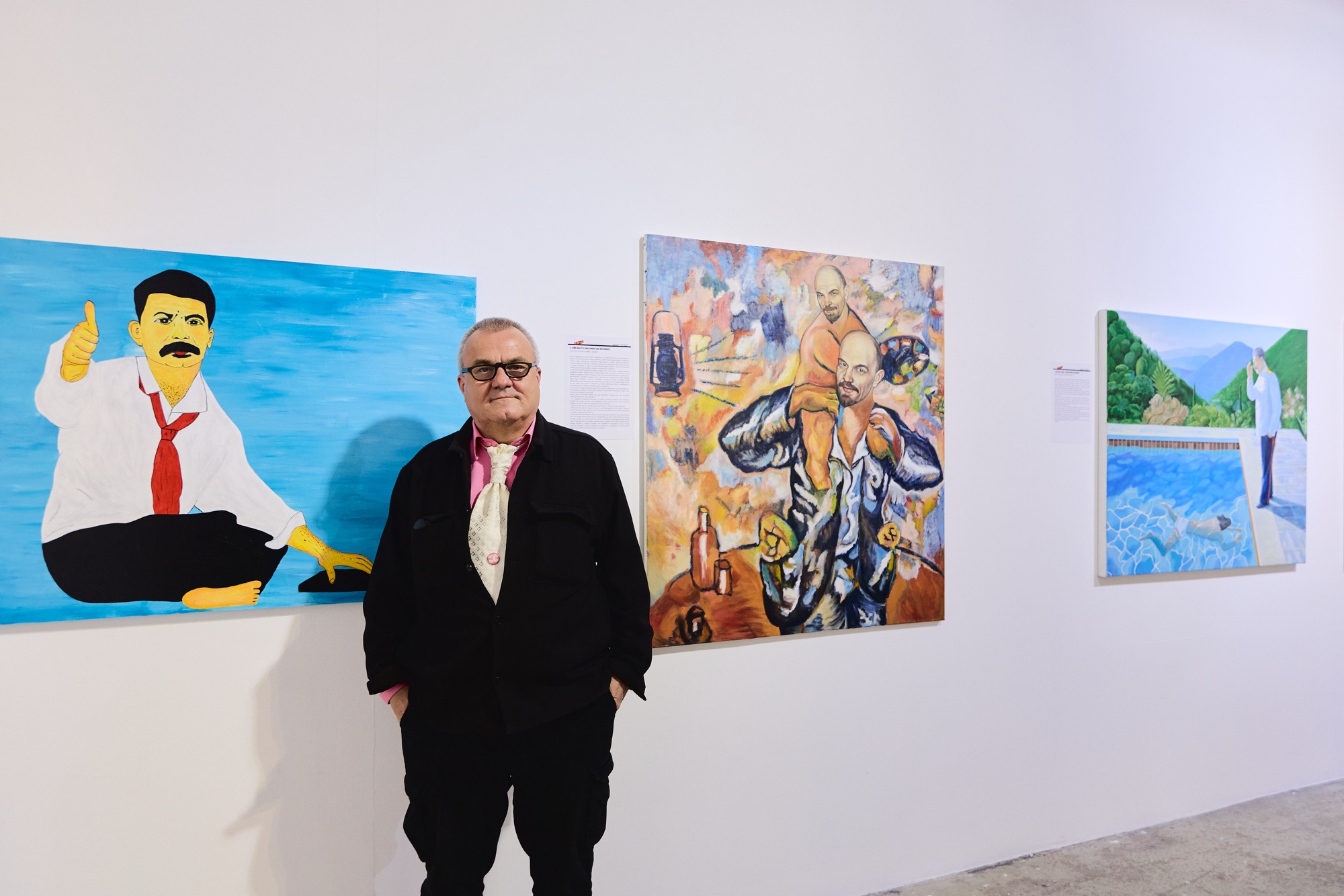
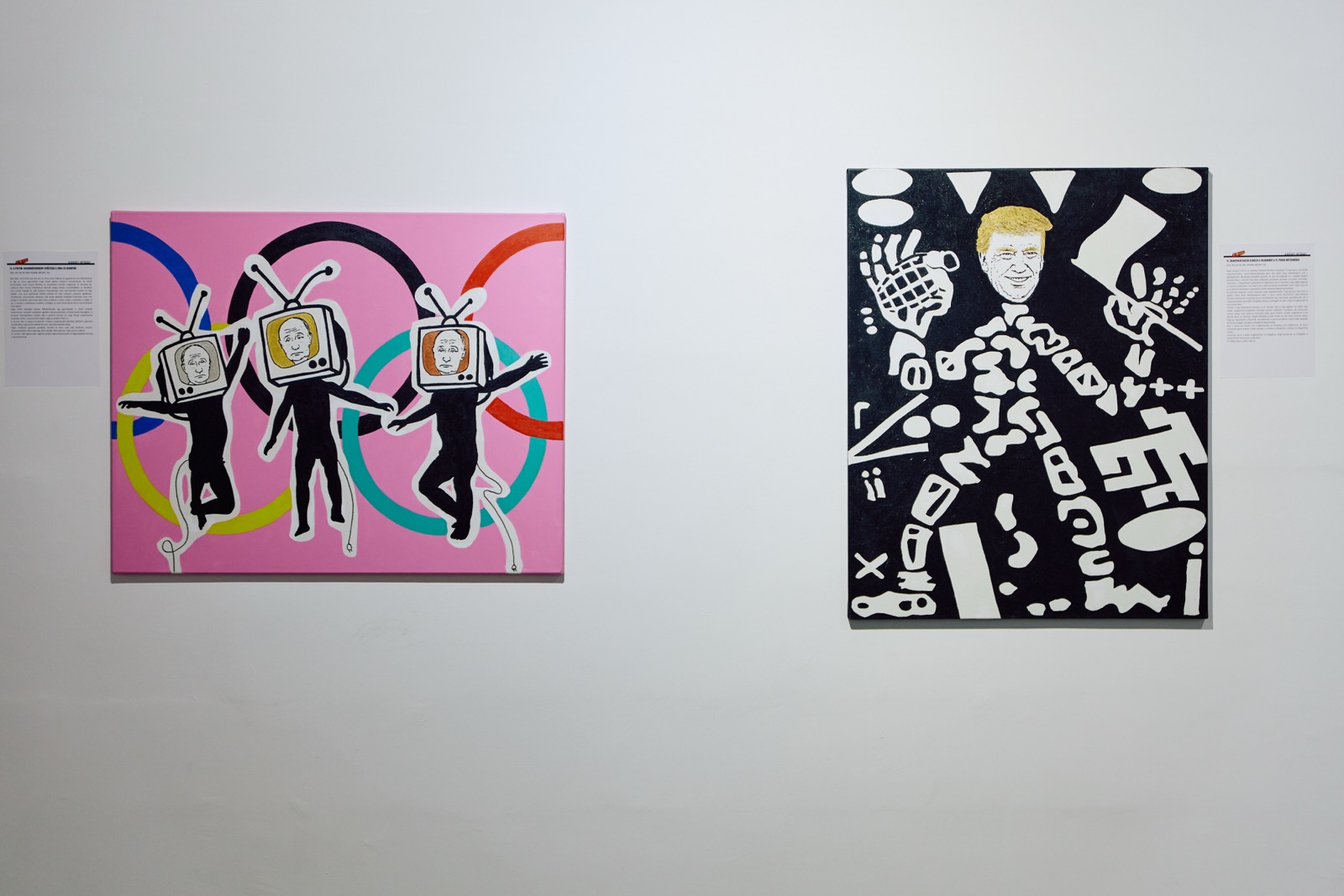
If we try to pull back the curtain, to see beyond the paintings of Eastern European chicks with Hitler dildos, the feminist Mussolini, vampire George Soros, Stalin as Manager of the Year, and Arnold Schwarzenegger teaching Trump how to swim — where does all of this actually come from? Who is the dr.Máriás behind the paintings and the music?
Well, dr.Máriás is a curious, kind person who sees that there are all kinds of strange things in the world. There are many masks, many disguises, many lies, many grotesque things. And he tries to respond to these with a kind of positive, cheerful, stripping-away, humorous, life-affirming – and sometimes cutting-to-the-bone – irony. He tries to present images, or play music, that comes from some instinctive feeling for life, and whose aim is to liberate, emotionally, those people who encounter this art.
Looking back over the past forty years, how would you say your craft has changed? You have written that your artistic journey began with a desire to tell your own stories. Is storytelling still your mission?
Yes, absolutely. Fundamentally, I think of visual art as narrative too — though as a kind of narrative that isn’t unambiguous, not as unambiguous as written text, and not as abstract as music, both of which I also work with. It has this playfulness of interpretive fields, and that is very exciting, because a painting can be read this way, or that way, in several different ways.
In this large exhibition, which occupies 1,100 square meters and presents different periods, it is fairly easy to experience and see how, in different eras, I dealt with storytelling, and how I moved from a more closed, introverted, hermetic artistic language toward one that opens up much more, turns outward much more, communicates, provokes, and addresses social problems more directly. My personal breaking point on this journey was probably the experience caused by the Yugoslav War itself, when I lost the illusion that one could flee or escape into an ivory tower — whether as an artist or as a viewer. I thought that art must communicate, in any case, and must speak about things that need to be discussed, things that should elicit a kind of sociological or social reaction from another person.
I’d like to go back to your youth. In another interview, I heard you describe Tito’s Yugoslavia as something similar to Hungary, only a bit more disco and a bit more colorful.
You grew up in Novi Sad, and your book contains vivid scenes from your childhood there. For people who come from more homogeneous communities, it can be difficult to grasp the profound questions of identity that you so playfully describe in your book. I grappled with this myself as a child born into an immigrant family in America. I was often not quite seen as American, but I also encountered a similar distance from Hungarian acquaintances.
Your book caused those memories to come flooding back. I spent an evening reflecting on how my own treatment of this issue has changed over the years. How would you explain to someone who was not born into that environment how it shaped your identity? And today, do you consider yourself Hungarian?
It’s very interesting when a child leaves the closed, homogeneous family world – usually homogeneous because of certain compromises, compromises that have taken shape – and emerges from a homogeneous cultural, linguistic, national, or religious identity into an outside world that is different.
At first, of course, one feels a kind of fear, a kind of foreignness, a kind of alienation, but also curiosity. While I lived in Yugoslavia, I didn’t really notice how much the local cultural and other identity-forming factors shaped me. I’m Hungarian, or at least I define myself as Hungarian, and my mother tongue is Hungarian. But I can speak Serbian, Serbo-Croatian, at the same level, although I long thought of it as a foreign language.
It was very interesting when I started university. I read so many texts in Serbo-Croatian that it became my first language. For instance, I began dreaming in that language. That frightened me a little: how does this work in the hierarchy of languages, or in the hierarchy of identity-forming factors?
Later, those who saw the Hungarian in me – and in a certain sense saw an ethnic enemy – essentially drove me out of Serbia, among other reasons because of my Hungarian identity. Then I ended up in Hungary, where I realized that I wasn’t like the Hungarians here. In fact, culturally I was almost completely different. I had been formed in a different environment and had absorbed the cultural traits, dynamics, and value system of another milieu.
Two cultures, two identities, or a mixture of them, are present in me simultaneously. When I think about what makes me different from visual artists in Hungary, I can obviously look for some kind of origin there: I appear on this Hungarian scene with a Yugoslav or Balkan temperament, with a more provocative, bolder, louder relationship to things, and a more forceful language. There is really no other artist on that scene with a similar dynamic or disposition.
Artists born and socialized in Hungary are much more reserved, inward-looking, intellectualizing — or more “bluestocking,” so to speak. Whereas in me, somehow, this primary energy, this directness, and so on are much more present. Even in temperament, or let’s say in my artistic language, I am very blatant. This is strikingly noticeable.
.png)
I often felt that certain dualities kept reappearing in your last book. On the one hand, you describe very clearly what you disliked about the conformist dictatorship you grew up in. At the same time, you write about your family and your childhood home with such deep, almost devotional love that it comes across as genuinely reverent.
There is another duality in your parents as well. Your father, if I understood correctly, was a military doctor, while your mother was an artist. On the surface, those roles might seem almost opposite: two very different positions in the world. And yet, from that combination, you describe a childhood that sounds almost like paradise — full of safety, warmth, and protection.
Do you think there is some truth in that tension? That a political system can be oppressive, even suffocating, and yet a child inside it can still find or experience the world as a safe and enchanting paradise? Or, to put it more deviously: can dictatorship be good — for children?
I would rather say that time and memory beautify many things. In Imre Kertész’s novel Fatelessness, when the protagonist returns to Budapest from the camp and cannot find his place, every success, every attempt at survival, every achievement is really tied to his previous life, to when he was a prisoner in the camp. So in freedom, he no longer finds his place; he feels it to be alien and does not understand its logic. He had simply been socialized into that other world, where he had managed to preserve his life through the most severe, most refined tricks, the hardest work, and endurance.
Something roughly similar may apply in my case too. Obviously, there were many things that weren’t good, but a person can’t know right away whether a negative experience will ultimately be useful in life or not. In fact, perhaps we learn the most from the most negative experiences, and draw the most important conclusions from them. Or later, only in relation to those experiences can we truly rejoice in good things.
For example, the fact that I was torn out of one culture and had to be completely resocialized in another was, at that moment, a painful experience. Yet today I would say that I am in a situation where I can, in a certain sense, pride myself on a cultural surplus or an identity surplus compared to the average person living here. Of course, there are many people here with all kinds of backgrounds, but these kinds of experiences can have their own advantages.
When I remember my childhood, there were obviously many painful, exclusionary, and various other experiences. But over time these were overwritten by the fact that, somehow, one became richer through them, became more because of them, and because one has so many experiences, so many acquaintances, friends, and so on.
In truth, those people became the people close to me who shaped my personality. Even if one or another of them was not necessarily a positive figure, I could draw something from everyone. I could pull myself out of certain difficult situations; I could survive. And in the end, this survival functions, I think, as a kind of success, or a kind of key, in a retrospective perspective that partly reckons with that melancholy.
.png)
You speak about Hungary as a dictatorship. In some of the circles I move in – where lawyers and academics scream like banshees about definitions – everyone has a different term. They interpret Orbán’s regime differently, or use other words to describe what Orbán built.
Some would argue that it wasn’t a dictatorship. Yet you use that term with an almost mischievous seriousness, with the confidence and ease of someone who can argue all sides. So what is it?
If we analyze it very seriously, then fundamentally we can speak of a hybrid system, one in which there were democratic elements. But essentially, one party, one kind of identity, was able to dominate the entire country so strongly that, in this sense, the ruling power became so monolithic that this is what I meant by dictatorship.
There are elections, there are parties, there are many things. But power, money, information, networks, structures, international connections, opportunities — all of these are so concentrated in the hands of one party that even if, legally speaking, it cannot be called a dictatorship, from the point of view of someone inside it, it can still be experienced entirely as a dictatorship.
Wherever I turn, I always run into the same wall. There are not two possibilities, not two doors; there is one door. Either I go through it, or I do not go through it, or I am not willing to go through it, and then I have no opportunities at all.
I’m not saying that everywhere else in the world there is freedom, or that everywhere else there is democracy. I think there are problems with democracy in many places in the world. Elsewhere one might not call it dictatorship, perhaps one would call it a taboo-ridden public life or taboo-ridden societies. But what existed here for sixteen years, I can say in good conscience, and I still stand by it: according to my own conception of freedom, I interpret it as a dictatorship.
Regarding the cultural sphere, correct me if I’m wrong, but I don’t think you appeared in any state media. I certainly don’t think you appeared in public media, though maybe you know better. There was a feeling that your art was not exactly banned, but that they simply did not want to deal with it. It was awkward: the way your art held up a mirror to a distorted reality. Did you experience censorship in Hungary?
This is an extremely interesting question, because it cannot be answered unambiguously. Censorship wasn’t the same at every level or in every place.
Fidesz came to power in 2010, and at first it seemed almost positive. The restrictions and this internal censorship, classification, and so on, were introduced gradually. Eventually, the whole system reached the point where, although they denied it, there were blacklists.
I know from television colleagues that there were lists containing names of people who could not be invited as guests, or who could not be interviewed, and so on. I was banned from public television, radio, everywhere, during the last, I don’t know, ten years. Before that, they had made radio plays, even an hour-long portrait program, called me for interviews, and so on.
I was completely banned from state exhibition venues as well, though of course no one ever said this openly to my face. It was very reminiscent of socialist times, when they did not say, “You are the enemy,” but you simply came to understand that you were the enemy, that you could not express your opinion, that they did not believe you, and that they looked through you.
What really developed, as a result of excessive concentration of power, was a kind of self-censorship within the apparatus. This strongly resembled the socialist period, when various cultural organizers, workers, reporters, and so on were afraid that they would be held accountable for something. So they introduced self-censorship.
When Árpád Göncz was elected the first president of Hungary after the change of regime, he said in his speech that the most dangerous thing here in Eastern Europe is self-censorship, because we were trained for it during the years of socialism as well. I think he was completely right. This self-censorship leads to everyone eventually doing only things they are sure will not cause trouble, will not create a problem, will not provoke debate, publicity, noise, or success.
Then this becomes a suffocating counter-selection, and you end up dealing with, exhibiting, and presenting things that are not very interesting, not very current, not very relevant. It does not deal at all with the sensitive issues that are otherwise the most interesting and most important to people.
In that counter-selective process, I was basically blacklisted from the very beginning. Over time, even much milder or less outspoken artists were affected too, because cultural institutions were forced into a kind of intellectualizing, more closed attitude. Serious classical music cannot cause much trouble, abstract art cannot cause much trouble, and so on. Somehow the entire cultural sphere ended up there.
This didn’t only bring about a kind of lack of interest, but also created a terrible problem: contemporary art and modern culture didn’t have as much influence on younger generations as it could have had in shaping their personalities, their thinking, and enriching their lived experiences.
Because everything became such a restrained, castrated, semi-communist program everywhere – from snobbish culture to peasant culture – we missed the opportunity for young people to connect more directly and intensely, through art, to the discussion of social questions, or to a more classical understanding of them, and to want to participate in them more, to feel them closer to themselves.
But, as it turned out, although this connection was missing, politics still unexpectedly played a very strong role in the lives of young people. I think we owe the election result above all to them, because an entire young generation felt that it had no point of connection with that world and wanted nothing to do with it, alongside those who perhaps had never voted for that political direction anyway, or had become disillusioned with it over time.
.png)
.png)
Authoritarian systems do not only produce self-censorship. They produce eager volunteers, artists who sense what power wants from culture may begin to offer it before they are even asked. Over time, this creates a bootlicking culture. And sometimes, that organic bootlicking culture can become the official culture.
Your own story suggests that your own relationship to art developed very differently: through friendship, music, informal encounters, and the messy, organic process of discovering the world by yourself and with others. But authoritarianism distrusts the organic, unless it happens to be growing in the direction of obedience.
How should history remember the artists who chose to serve that system not out of fear alone, but out of ambition, comfort, or calculation?
I think they won’t be able to wash that stigma off themselves. Of course, part of society does not even see it in them, but I think that, in the process of society’s purification, these things must be emphasized and, in a certain sense, reckoned with.
This bootlicking culture arises because, for a power structure, the most important quality is loyalty. And so it counter-selects people within its hierarchy, not according to their knowledge, their work performance, or their artistic value and originality, but according to their loyalty.
Over many years, this created an artistic class whose better part, in fact, is very mediocre and otherwise would not really have succeeded — certainly not to this extent. These artists received not only financial opportunities in the form of support, but also opportunities to appear everywhere: on radio, on television, at festivals, at major state celebrations. They simply dominated the field. They dominated the discourse. They became the artists; they became art itself.
Now, reversing this, reversing this entire value system, and saying that from tomorrow onward we will determine who is a good artist based on artistic value, or market value, or some other values, and who is a traitor because they collaborated with these people and served them and stupefied the public just so that more votes could be gained through them — that won’t be simple.
It will work to some extent, but it will not be easy, because people’s attachment to these artists sometimes happens through politics. No matter how much the other side proves that a given artist is worthless, lacks credibility, or is even trash-quality, the ordinary voter or average person may still cling to them, buy their products, value them, and so on.
So when a new government is formed, a new cultural policy will obviously have to be very firmly defined. And within cultural policy, it will have to define what quality is, or how those values can be expressed which, from market, ideological, historical, and other points of view, have so far been disadvantaged.
How can they now be compensated, in a certain sense, and brought to cultural consumers in such a way that their value is shown, and that they receive opportunities in terms of publicity, presentation of appropriate quality, and so on?
This will be very difficult, because Hungarian society is divided, and Fidesz and Viktor Orbán played on this division to the maximum. In fact, the system collapsed because this division could no longer be stretched any further. This opposition – let’s simplify it and say: opposition to European values – could simply no longer be intensified.
But how can this opposition be dissolved in people’s minds and hearts, where these polarizations still exist today? Who knows how long they will remain this way? How can a dialogue begin, and how can quality be presented? That will be one of the most delicate and most difficult tasks. How can a cultural institution or organizer withstand various pressures? To what extent can cultural policy operate according to its own value system, rather than functioning as a secondary sphere serving the representative function of political interests?
.png)
From circles close to power, the artists themselves eventually became the artwork: living exhibits of the regime’s own twisted imagination. Over time, the performance became so excessive that, in the public eye, it tipped into parody. Many people in the cultural world still remember that period with anger and hurt, but there was also something revealing and almost beautifully absurd in watching official culture parody itself into exhaustion. That process, too, felt organic, and says a great deal about culture, including Hungarian culture.
What was it about Hungary under Orbán that allowed this to happen not just in the arts, but throughout society?
Look, I would begin with a parallel. Because of my Yugoslav historical or identity background, I often draw parallels and try to learn from them as well.
If we look back at Tito’s dictatorship, which for about four decades tried to modernize an almost feudal society, it apparently had fantastic results. In Yugoslavia in the 1980s, the most important Western European artists exhibited; books of fantastic quality were published; very high-quality professionals appeared in society; the whole culture reached a very serious level.
Then came a twist in politics and war that threw that entire identity back, I don’t know, a hundred years.
I say this only because in Hungary, by “civilization” I mean the strong social formation or presence of certain value systems, certain basic legal principles, principles of identity and acceptance. I mean not trying to denigrate another person because of their ethnic or religious origin; not kicking someone or looking down on them because they are disabled, or whatever.
These are trivial examples, but in Hungarian society, this four-times two-thirds majority was obviously the result of a recurring reflex. It was, in fact, the revival of the socialist world of experience within a new generation.
This presumably could not have been done in another society — in Austria, Belgium, Iceland, Canada, Georgia, or wherever. What was needed here was that socialization, that historical experience, those negative and positive experiences, that sense of having been socialized into the idea that, after all, socialism was good for us, because we had Trabants, we did not have to work much, and we had everything.
These imaginary, idealized stereotypes were revived. Through the disproportionately strong reinforcement of a kind of middle-classness, or some stereotypical thought, they unfolded into a social movement in which a monolithic, dumbed-down value system, with its own lies, ruled over half or two-thirds of society.
If there had been a richer background, and a higher degree of civilization, historical experience, and clarity, this could not have happened. It would not have been possible to dumb down culture and political communication to this level. People would not have tolerated it — or at least not for this long.
But for this, that negative element was also needed: the element that, feeding on hatred, voted for this rather than the other side out of a certain feeling of revenge.
These historical wounds arise from a kind of incurability, and they live in us. They are carried through generations in almost every family and apartment. Until we can in some sense heal these wounds – or at least civilize them, so to speak, force them within certain limits – then any new extreme phenomenon of whatever kind can truly happen again.
What could stop it, except a collective, shared value saying: “Listen, this is simply not acceptable”? And this would need to have some kind of control in the media and in society as a whole, in a strong and somehow unbreakable way.
Of course, in a small country, what I am saying immediately sounds like a kind of utopia, because due to all these different kinds of pasts, these conflicts and these different interpretations can flare up and collide at any time.
.png)
But to return to your work: the figures, motifs, and political references you use clearly exceed Hungary’s borders. Your work seems to belong to a wider global vocabulary. How do you see that broader context? Have you experienced anything of the sort?
I understand it that way too. I began exhibiting and giving concerts abroad in the 1990s, and we played a lot in all kinds of clubs, from New York to Saint Petersburg, and from Rostock to Belgrade. Often, alongside a concert or a festival appearance, there was an exhibition, or something in separate galleries.
I saw that everywhere people understood this so-called artistic language. I was very happy to exhibit in London, Vienna, and Stuttgart. However, after a while I had to face a problem: Western Europeans, and Westerners in general, did not distinguish between the system and anti-system art.
They put everything into one box: if someone is Hungarian, then they must be an Orbánist. And even if the artist criticizes Orbán, they are still angry at him, because they do not want to deal with Hungarians at all. They do not want to mess with the whole topic, so they leave the whole thing alone.
So after a while it became embarrassing to appear in Western Europe at all – leaving Eastern Europe aside – to reflect on the whole situation, to deal with it, and to say, “Yes, sorry, I also come from there, I am Hungarian too, but I do not agree with this, and I did not vote for this or that.”
That was the other problem: after a while, we were all thrown into the same box, all of us together, and they turned away from us. As a result, I actually lost the desire to exhibit abroad. I had one or two invitations, but I preferred to stay at home and not to exhibit.
Obviously, in recent years, the technical possibilities for realizing such things have also become increasingly limited. Earlier, there were cultural institutions, institutes, grants, that helped make a foreign presentation, performance, or exhibition possible. Naturally, for the last ten or more years, I have been completely excluded from these.
The opportunities and the interest changed, so unfortunately, I have not exhibited abroad since the late 2010s. Before that, I had exhibited twice in New York, in Barcelona, and in major cities, in various galleries and festivals. But recently, unfortunately, no.
My own experiences in Hungary baptised me into the world of overzealous nationalism, where “wrongs” are not “wrongs” if they are committed by “our own.” In fact, there might even be virtue in those “wrongs” — as in the case of the Orbán government’s relentless anti-Ukraine propaganda. Can Hungarian culture help repair that relationship?
I think Hungarian culture, Hungarian identity, is not hateful. The Hungarian spirit, Hungarian identity, is very, very open and receptive. What became the hobbyhorse of politics in recent years is a very condemnable, negative, sad, unfortunate chapter of Hungarian foreign policy, and of Hungarian politics as a whole.
I think this can be made right and Hungary could obviously make gestures in this direction by somehow presenting Hungarian artists to Ukrainians, and Ukrainian artists to Hungarian society. By drawing closer, by getting to know one another, and by understanding one another’s difficulties through our art.
When some stupidity, an article, or a television segment wants to arouse hatred in a person, it obviously clouds the perception of the average recipient. It obscures how many suffering people are behind that surface, how many dead, how many wounded families, relationships, deaths, and so on. Obviously, if these human dimensions can come closer to one another, that is the best way for such a relationship to be restored, healed, and improved, and for people on both sides to extend their hands to one another.
dr.Máriás is a Hungarian visual artist and musician born in Novi Sad, Yugoslavia. Working across painting and performance, he is known for his provocative, darkly comic canvases that place historical monsters and political figures in absurd, often surreal juxtapositions — Stalin as Manager of the Year, a feminist Mussolini, vampire George Soros. His work draws on decades of living inside and against authoritarian systems, from Tito's Yugoslavia to Orbán's Hungary, where he was effectively blacklisted from state institutions for over a decade. His 2026 exhibition Long Live Dictatorship opened alongside the publication of his memoir, marking both a personal retrospective and a reckoning with Hungary's political transformation.